
Gameplay Insights #7: Our Take on RTS
Greetings, Astra Odysseans!
We hope you’re doing well. We’ve been working on Beyond Astra, our first game, for almost seven years now. Development is taking longer than we imagined, and your patience and your messages of support mean a lot to us. Thank you as well for your feedback on these DevLogs: sharing the game with you as it takes shape is a real pleasure. Right now, Valentin is finishing up gameplay loops and fixing issues ahead of the beta.
Beyond Astra is built on 4X mechanics, enriched by grand strategy and its six pillars (covered in Gameplay Insights #2 and #3) and by planetary city-building. Today we’re looking at its RTS side: real-time combat.
What we keep from RTS
What draws us to RTS games is choosing between priorities: produce or invest, expand or defend, gather your forces, hold a position or attack. In Beyond Astra, your resources, your information and your decisions give you the means to face the other civilizations, the megafauna and the threats you’ll meet along the way.
That said, we want decisions and positioning to matter more than execution speed. Active pause and adjustable game speeds are there for exactly that. You can pause the game, assess the battle and issue your orders, then resume when you’re ready.
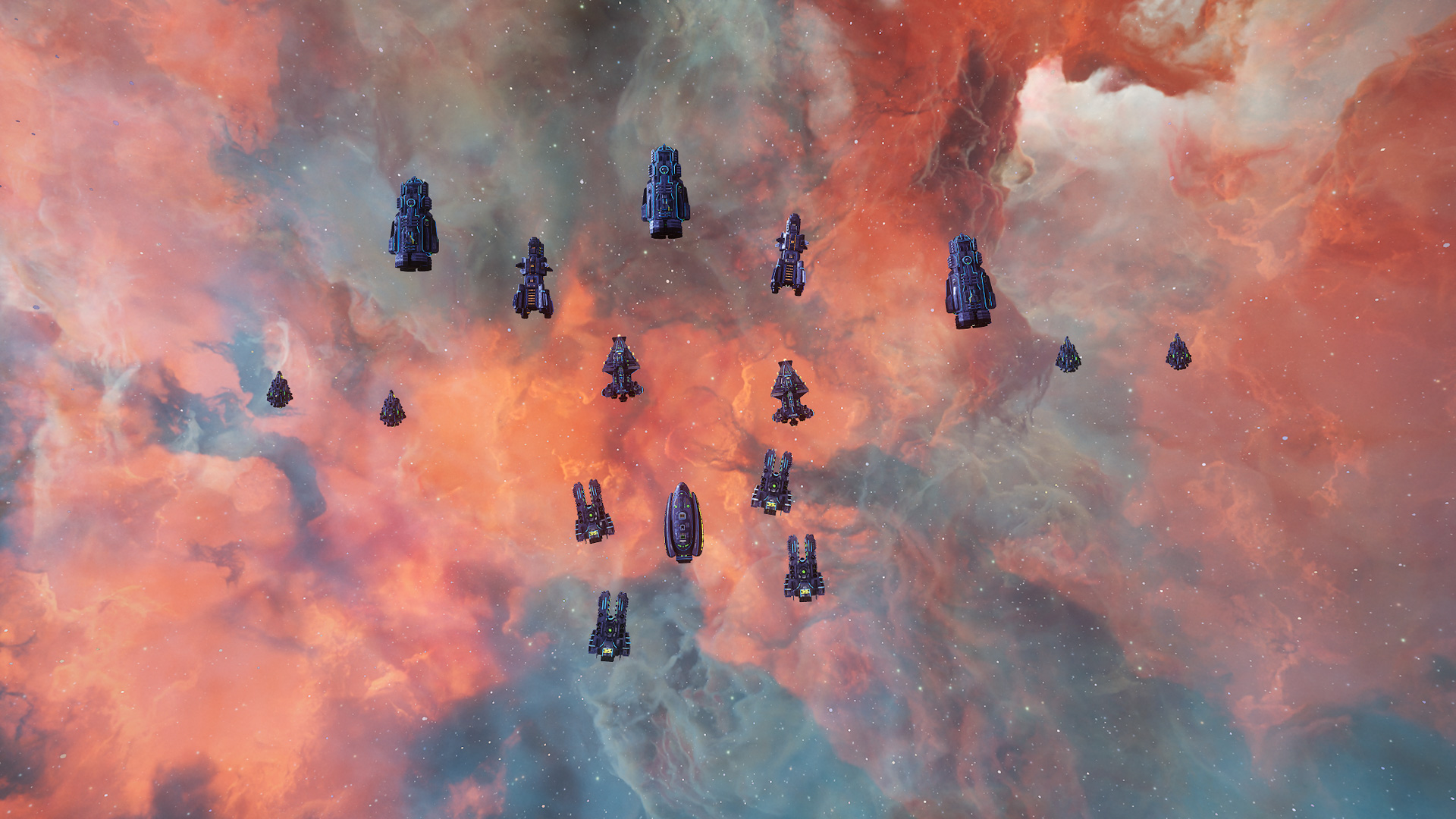
Zooming in and out also lets you make decisions at different scales. At the galactic scale, you choose where to commit your forces. As you zoom in, you identify unit roles and threats, then direct maneuvers on the ground or in space. The seamless zoom isn’t just a visual showpiece: it’s a command tool.
Every unit counts
In the late game, you’ll command fewer than a hundred units, ground and space combined. We want your army to stay manageable throughout the game, with every unit easy to recognize. That’s the balance we’re striking between the scale of battles and their readability.
The six ship classes (Pioneer, Raider, Artillery, Escort, Cruiser and Vanguard) are designed to complement and counter each other. Each has its own base stats, its bonuses and a weapon unique to its class. The main module deals most of the damage, external and auxiliary modules round it out. This split is meant to keep each class’s role distinct and to strengthen the interactions between them.
Every unit is an investment. Losing one costs you the ship, but also the military population aboard. Your Command Points limit the size of the army your civilization can maintain. Protecting, repairing or pulling back a Space Vanguard also means preserving the effort that went into building it.
Information is a weapon in its own right. Each class has its own vision cone. The Pioneer ship sees farther than it shoots, while nebulae can hide units. Locating the enemy and surveying the area help you prepare for an engagement.
Once combat starts, numbers aren’t everything. A flanking attack, an ambush or a good firing angle can change the course of a battle. Hitting the engines or disabling a module can also deprive an enemy unit of an ability, rather than simply reducing its hit points.
Combat on the ground and in space
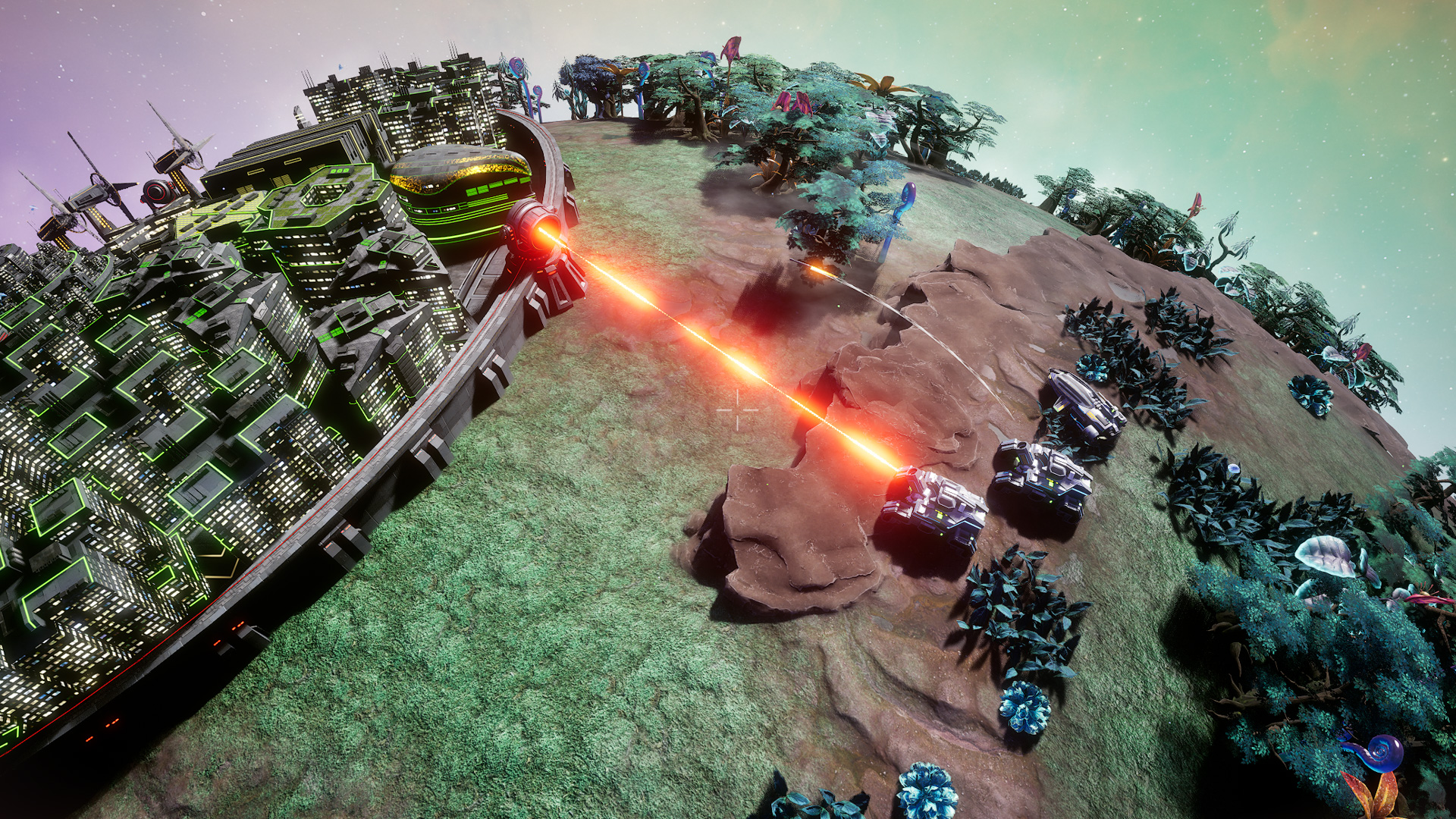
During the alpha, ground combat and space combat ran on two separate systems. On the ground, armies were made of groups of infantry, and the fighting was hard to read. Today, ground armies field large units several hundred meters long, crewed by thousands: land ships, in a way.
The two systems have grown closer, but ground and space remain distinct environments, each with its own constraints. The seamless zoom lets you move from one to the other within the same battle.
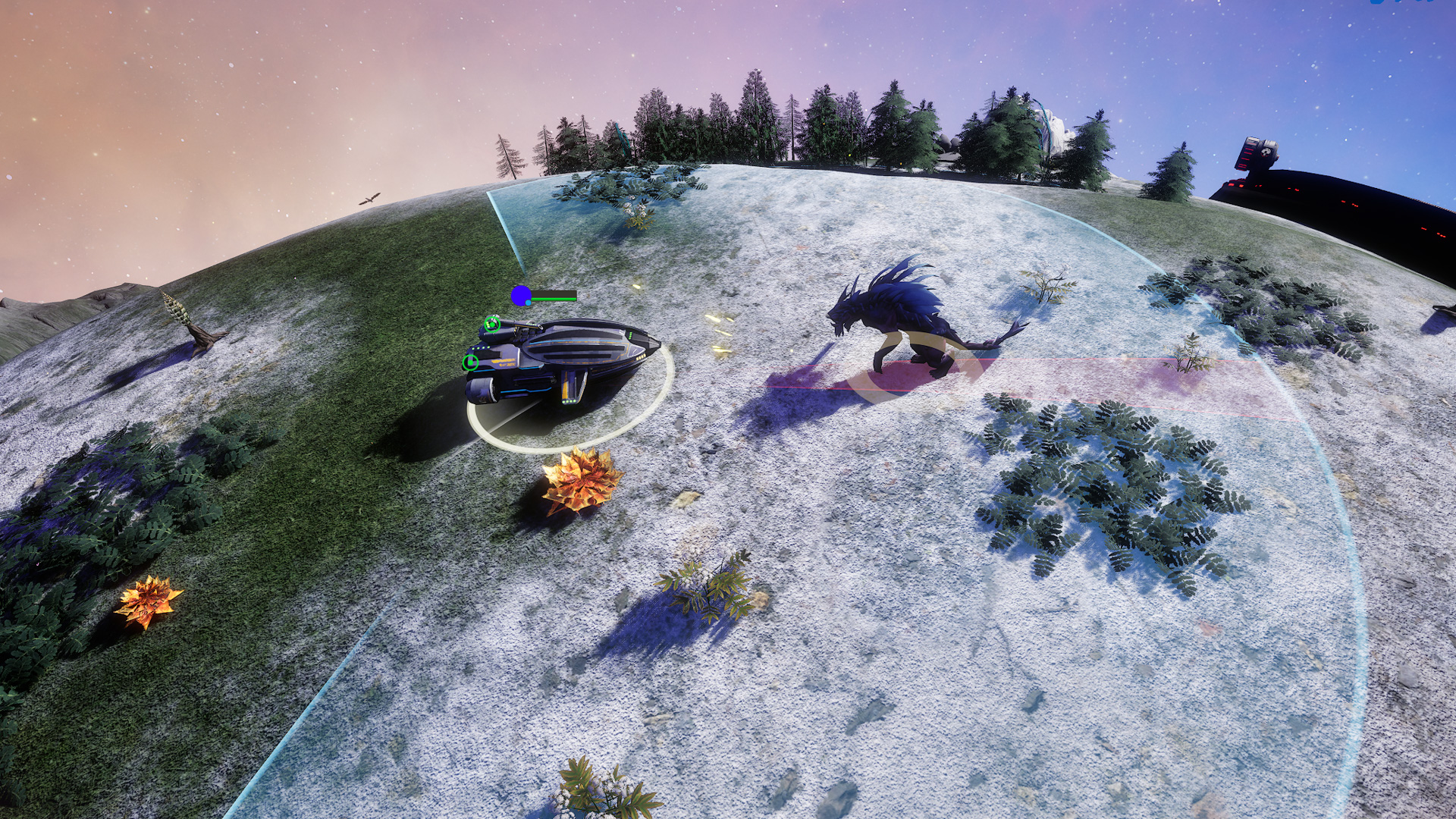
On the ground, every procedurally generated planet has its own terrain. Obstacles, forests that conceal units and differences in elevation all shape the fighting. Your fleets can carry your troops from planet to planet. From orbit, they can also support the offensive below with fighters and bombers, or with an orbital bombardment.
Space is vast, but it isn’t empty. Your ships navigate around celestial bodies and use the gravity of planets and stars to travel faster along some routes. You’ll need to account for these conditions when positioning your fleets, arranging your formations and planning your approaches.
Most planets are also home to wildlife, including megafauna, and space has its own life forms. The other major civilizations aren’t your only adversaries. You may run into megafauna nests, pirates and their flagship, guarded ruins, or galactic crises.
On the ground as in space, projectiles follow physical trajectories and can miss their target. Units are armored differently on the front, the flanks and the rear, where the engines are a weak point. Defensive countermeasures, notably flak systems, help fend off torpedoes and homing missiles. Special auxiliary modules add further ways to customize your units.
We also want battles to be satisfying to watch, with the sound of shells and projectiles streaking across the battlefield. You can see a shot being fired, follow its path and see whether it hits or misses. And behind every fleet on the move is everything your civilization has built to make it possible.
You don’t pilot, you command
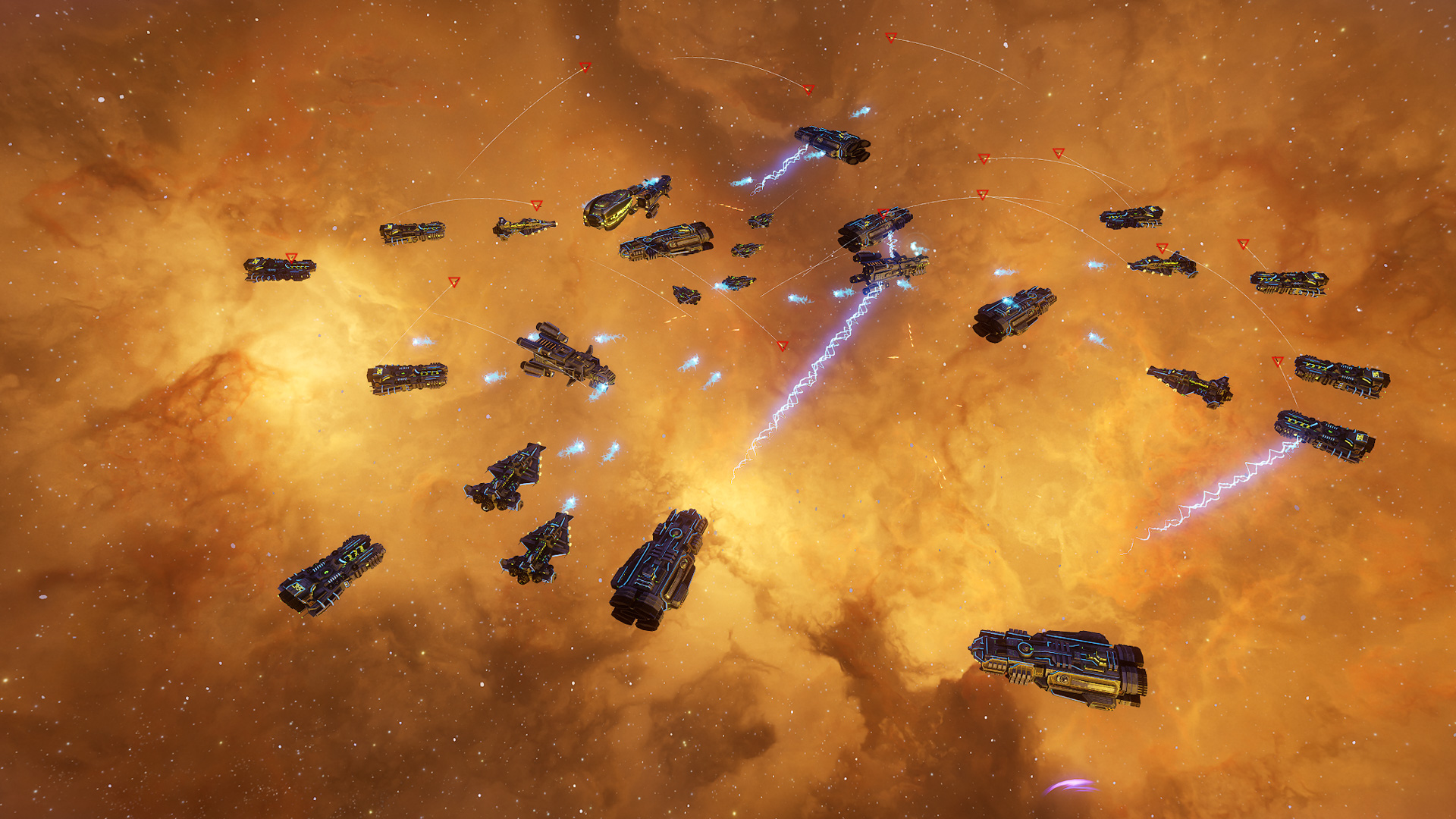
Every unit carries a combat computer, chosen in the Unit Designer, that defines its default behavior. It can keep its distance and bombard the enemy, kite while falling back, close in for a brawl, circle a target to fire broadsides, maneuver behind an enemy, or stay close to an ally and take hits for it. Your units move and fight on their own, in a way that fits their class and the computer you picked.
You choose how much you want to step in. You can let these behaviors handle the routine maneuvers, or take over to dodge, flank, focus fire or withdraw.
Retreat is one of those decisions. Committing to a fight doesn’t always mean you have to see it through, and moving in reverse lets you fall back without exposing your stern to the enemy. Positioning also helps protect your units: an Escort can screen your most vulnerable units from Raiders.
On the move, your fleets travel at the speed of their slowest unit and stay grouped, adapting to the terrain, to obstacles and to orbits. You can order them into a formation (Front Line, Escort or V formation) and use your mouse to set its facing.
Progression built for single-player
Designing Beyond Astra as a single-player game gives us some freedom in balancing, especially to offer powerful and varied progression paths.
Technologies unlock better modules, more firepower, tougher shields and megastructures. Exploration and battles against wildlife or pirates also yield modules you can’t get any other way.
Military Traditions form an experience system that spans your entire civilization. They raise your units’ ranks and give you access to bonus cards as you progress.
Your economy, your politics, your culture and your religion can support the war effort as well. We want every major pillar of the game to contribute to a military campaign and shape the way you fight.
Your units, your story
We’ve spent years looking for the right balance, so that the RTS, the 4X, the grand strategy and the city-building of Beyond Astra fit together and feed into one another.
We hope you’ll grow just as attached as we are to the units you design, name, repair, and refuse to sacrifice. 🙂
If Beyond Astra sounds like your kind of game, adding it to your Steam wishlist is a simple way to support us. You can also join us on Discord to follow development news.
Toward Astra, and beyond!
Alex & Valentin